

A proposed mountain bike stage race to be held in the Tally Lake Ranger District is being met with opposition from a local environmental group.
Keith Hammer, chairman of the Swan View Coalition, submitted a four-page comment to the Forest Service contending the bike race will promote conflicts and collisions between cyclists and wildlife. . .
"Trail runners and bikers alike have been swatted, butted, mauled and killed during surprise encounters with bears, lions, wildebeests, and other wildlife," Hammer said in his comments to the Forest Service. "While folks can get hurt hiking, wildlife and land management officials have become fully aware of and advise against the added risk of increased trail speeds involved in running and biking." . . .
"We urge Flathead National Forest to confine speed sports to the developed Big Mountain area so the negative impacts to fish, wildlife and human safety do not spread across the forest," he wrote.
Read the full Whitefish Pilot article here.
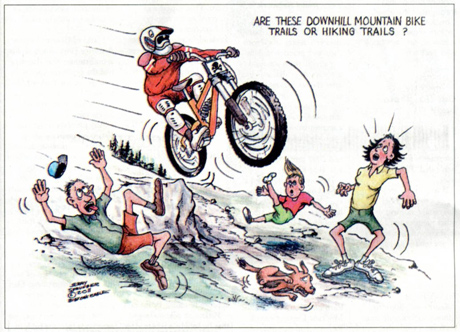
Freeride mountain biking has become an increasingly popular sport in the Missoula area over the past decade or so. Advancements in suspension technology have allowed for bikes specifically tailored to more "technical" terrain: steep slopes, jumps, rock drops and log ramps. But Missoula's legal trail system doesn't have much of that. The void is filled by an outlaw culture of freeriders bent on meeting their own demands, even if it means breaking the law. . .
"Historically, the Forest Service has allowed sort of conventional uses: walking down the trail, taking your horse, driving your ATV on a road," [Lolo National Forest's Boyd] Hartwig explains. "The mountain bikers who want a more challenging experience, they've taken it to the next step and said, 'That's not enough for us. We want to construct things. We want to build jumps and bridges,' or whatever. That takes us outside the bounds of what we're allowed to do."
Read the full Missoula Independent article here.

"The Montana Department of Environmental Quality and Flathead National Forest announced the news Thursday that Big Creek had been removed from the state's list of impaired waters. . .
Practices for reducing sediment . . . included decommissioning 60.6 miles of forest logging roads, removing 47 culverts and replacing 19, improving 89 miles of roads to decrease stormwater runoff; revegetating 25 acres of eroding uplands, and working with Montana Fish, Wildlife and Parks to improve the amount of large wood in headwater streams that feed Big Creek. . .
Road building and timber harvesting led to accelerated soil erosion and substantial increases in the amount of sediments delivered to Big Creek."
Read the full Daily Inter Lake article here.
Sixty-one percent of Flathead Beacon readers polled say they support our lawsuits to protect the Spotted Bear wildlife corridor!
Swan View Coalition and Friends of the Wild Swan filed lawsuits against two large logging projects in the Spotted Bear area in the past two months because they would fragment a critical wildlife corridor.
"With 23,000 acres of habitat flooded by Hungry Horse Reservoir, the Spotted Bear and Bunker Creek areas are critical habitat connectors between the Great Bear Wilderness, Bob Marshall Wilderness, and northern Swan Range," said Swan View Coalition Chair Keith Hammer. "Elk and other wildlife can't afford to have their critical habitat damaged by more roads and logging."
See our prior summary of the Flathead Beacon news article here.
Read the Flathead Beacon news article here.
A big THANK YOU to all of you that voiced your support through the Flathead Beacon poll!
We believe the margin of support would be even larger if the question were "Do you support protection of the Spotted Bear wildlife corridor?" rather than the double negative of "Do you support lawsuits protesting South Fork logging projects?"!
We hate having to file lawsuits - and we wish the Forest Service would change its logging proposals in response to public comments, rather than simply file more paperwork to try and make them sound better!
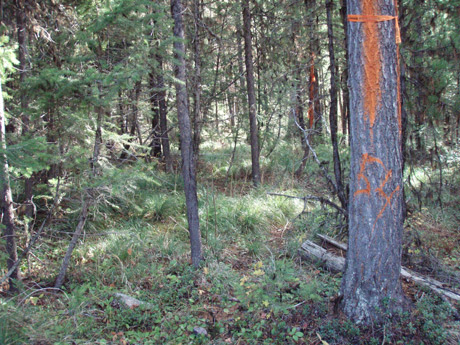
"Two local conservation groups have filed a lawsuit against the U.S. Forest Service objecting to a logging project proposed in the South Fork Flathead River corridor, the second time in two months the groups have filed litigation against a South Fork logging proposal.
Friends of the Wild Swan and Swan View Coalition, represented by Helena's Western Environmental Law Center, filed a lawsuit on April 16 in U.S. District Court in Missoula in opposition to the Forest Service's Soldier Addition II Project on the west side of the South Fork near the Bob Marshall Wilderness Complex.
In late February, the two groups sued the Forest Service over the Spotted Bear River Project, a logging proposal on the opposite side of the South Fork Flathead River. Both projects are located in the Spotted Bear Ranger District of the Flathead National Forest."
Read the full Flathead Beacon news article here.
The two logging projects are in areas connecting the Great Bear and Bob Marshall Wilderness areas to each other and to the Swan Range west of the South Fork Flathead River, corridor areas critical to wildlife that can't swim across the 23,000 acre Hungry Horse Reservoir!
We supported past timber sales that removed trees closer to Spotted Bear buildings and closed roads to protect wildlife, but these huge sales will reopen roads and log critical habitat far from human habitations!
"With 23,000 acres of habitat flooded by Hungry Horse Reservoir, the Spotted Bear and Bunker Creek areas are critical habitat connectors between the Great Bear Wilderness, Bob Marshall Wilderness, and northern Swan Range," said Swan View Coalition Chair Keith Hammer. "Elk and other wildlife can't afford to have their critical habitat damaged by more roads and logging."
Read about 61% of Flathead Beacon readers supporting our lawsuits here!

"Owing to the peculiarities of forest net primary production humans would appropriate ca. 60% of the global increment of woody biomass if forest biomass were to produce 20% of current global primary energy supply.
We argue that such an increase in biomass harvest would result in younger forests, lower biomass pools, depleted soil nutrient stocks and a loss of other ecosystem functions.
The proposed strategy is likely to miss its main objective, i.e. to reduce greenhouse gas (GHG) emissions, because it would result in a reduction of biomass pools that may take decades to centuries to be paid back by fossil fuel substitution, if paid back at all.
Eventually, depleted soil fertility will make the production unsustainable and require fertilization, which in turn increases GHG emissions due to N2O emissions.
Hence, large-scale production of bioenergy from forest biomass is neither sustainable nor GHG neutral."
Read or download the full Bioenergy paper here.
Read the Oregon State University article about this paper here.
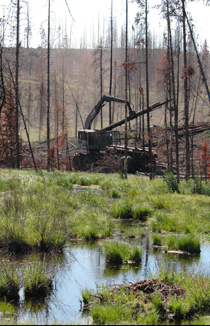 Dr. Richard Hutto summarizes his research into the ecological effects of severe wildfire as follows:
"The very fires often regarded as 'unnatural' and 'destructive' are the very fires that provide the best conditions for the most fire-dependent plant and animal species.
Land managers can't create the magic through severe cutting, fire is critical. . . many people believe that the conditions present after a clearcut or following one of the newer green-tree retention or forest restoration cuts are basically the same as those present after a severe fire. They are wrong."
(Read Full Article)
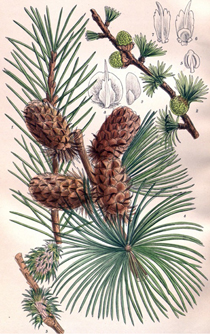 The Flathead National Forest released a proposal last week that calls for cutting down 270 of its biggest and healthiest western larch trees to acquire seeds that will, ironically, help restore the forest. . .
The Swan View Coalition is calling BS on the FS.
The group is asking supporters to contact the Forest Service and demand a less invasive process that saves some of the forest's strongest trees.
Read the full MIssoula Independent article.
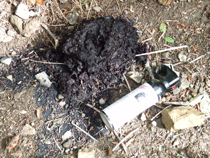 University of Calgary bear expert Steve Herrero was involved in two separate studies that looked at the effectiveness of bear spray and firearms in bear attacks.
The bottom line: Ninety-eight percent of those who used bear spray walked away from their encounter unharmed, and none of the people or bears involved died.
With firearms, 56 percent of the users were subsequently injured, and 61 percent of the bears died.
Read the full Missoulian article.
Keith Hammer photo: Bear scat laden with huckleberries alongside bear spray canister.
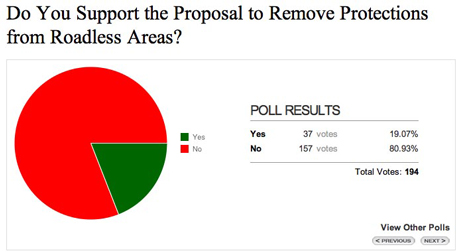
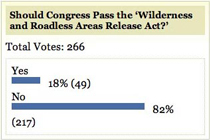 Over 80% of Flathead Beacon readers say they support protection of America's roadless lands in two polls taken six months apart. The above poll was taken in March 2012 and the one at right was taken in September 2011. Both polls were taken online by the Flathead Beacon relative to articles about the "Wilderness and Roadless Areas Release Act" cosponsored by Montana Representative Denny Rehberg, which would remove administrative protection of public roadless lands from developments like mining, logging and road-building.
Read the September 2011 and March 2012 Beacon articles.
Read about our roadless lands protection efforts and the Northern Rockies Ecosystem Protection Act on page 3 of our Holidays 2011 newsletter!
Page: ←123456→

