

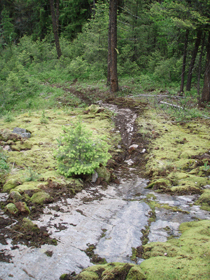
 The documents show that [Ron] Cron was fined $300 for three days he spent developing a trail on Crane Mountain after he said he found Swan Lake Ranger District employees unreceptive to his proposals to expand trails there. An agent found his hand tools on the trail, took them as evidence and left a business card. Cron later called and admitted building the trail.
"We purposely left the beginning and end of the trail obscured and not brushed out so it was not obvious because we knew we were doing something illegal," Cron wrote in the affidavit. "We wanted to build the trail first before telling the Forest Service because we knew once the trail was established it would never be removed." …
[Keith] Hammer believes any future public process considering mountain biking on Crane Mountain is illegitimate while the trail there already exists.
"The trails continue to be used and have been used for over two years," Hammer said. "So the entire process is biased until the Forest Service goes out and shuts down these illegal trails." …
Other emails by Forest Service officials express concern over how freeride mountain biking fits with other uses. That compatibility is what has Hammer concerned about the Beardance Trail, where riding features like elevated logs and other natural obstacles have been incorporated.
Read the full Flathead Beacon Article. While there, be sure to add your comments to help insure laws to protect wildlife and other forest users are followed on our public lands!
Email Swan Lake District Ranger Rich Kehr and Flathead Forest Supervisor Chip Weber today and ask that all unauthorized bike trails, jumps and ramps on Crane Mountain be removed to protect wildlife and other forest users!
rkehr@fs.fed.us and cweber@fs.fed.us
Read our previous article about Crane Mountain Trails for more background.
A Missoula woman jogging along a Crazy Canyon trail ended up in a boxing match with a black bear Friday morning when she inadvertently got between the bear and her cubs. . . The woman was nearly finished with her run in the Lolo National Forest's Pattee Canyon Recreation Area, east of Missoula, when she spotted the adult bear not far from the trailhead . . .
The 24-year-old woman then drove herself to St. Patrick Hospital, where she was treated for some scratches to her arms and chest, and released. . . She said it was her fault and the bear was just being protective.
Read the full story at the Missoulian.
The woman involved was Ani Haas, a U.S. Ski Team member from Missoula.
Read the follow-up story at the Missoulian.
It is the dream of the Crane Mountain Trail Supporters to one day have a mountain bike trail system on the hillside of Crane Mountain, but in the meantime the group is lending a hand to the Flathead National Forest Service by helping with trail work. . .
Not everyone is as gung-ho about having Cron and the Crane Mountain Trails working in the local forests though. Some groups, including the Swan View Coalition, are concerned about the larger motive behind the volunteer work and the overall well-being of the forest.
"Our main concern is that for at least two years, the forest service has allowed unauthorized mountain bike trails to exist and be used, and allowed unauthorized mountain bike jumps and ramps to exist and be used," said Keith Hammer, chairman of the Swan View Coalition.
Over the past month, Cron has visited the Bear Dance Trail with forest service employees, who have instructed him to remove some features that were being used for mountain bike recreation.
Read full story at the Bigfork Eagle.
"The problem is when hikers, bikers and dogs intermix," says Nick Hilbers, a 55-year-old hiker from Beaverton, Ore., who recently alerted local officials to an illegally made mountain-bike trail in a nearby city park.
These illicit trails have sprung up in several areas in recent years, helping spur the growth in sanctioned runs on federal lands. In the Lake Tahoe Basin, for instance, as many as 150 miles of unauthorized trails ringed the surrounding mountains a decade ago, says Garrett Villanueva, a Forest Service assistant engineer for the basin. . .
Some critics say the growth in flow trails could exacerbate conflicts, especially when the downhill bike-only runs are connected to shared-trail networks. "Are the bikers going to behave themselves? I'm not so sure," says Robert Francisco, 47, a hiker in Sacramento, Calif. "Mountain biker versus hiker on a steep descent is a bad combination."
Read the full article at the Wall Street Journal.
WHITEFISH - The director of Montana's lone 100-mile foot race announced the event's cancellation this week, explaining that lingering mountain snowpack would jeopardize runners' safety and make the requisite 36-hour finish time virtually impossible.
Dubbed the Swan Crest 100, the ultra-marathon race runs from Swan Lake to Columbia Falls through the Flathead National Forest, using U.S. Forest Service roads and alpine trails that take runners up, along and over the crest of the Swan Range.
Race director Brad Lamson said he recently hiked lengthy sections of the course and encountered deep snow covering the network of trails, including the Alpine Trail No. 7 that serves as the race course's primary route.
Lamson estimated that half the course remains buried under several feet of snow, concealing signs that mark critical trail intersections. The snowpack will not have melted out before the race is scheduled to start July 29.
"There is just no way to safely execute the Swan Crest 100 on July 29," Lamson said. "We really thought the snow would melt, but after venturing on two separate sections of the course this past weekend it became obvious that the snow was not going to melt in time."
...
Last year, a conservation group raised concerns about the route because it leads runners through proposed wilderness areas and specially protected grizzly bear habitat. Keith Hammer of the Swan View Coalition suggested the course be moved onto trails in less sensitive areas, and threatened litigation if it were not relocated.
Read full story at the Missoulian.
The man charged with grizzly bear recovery in the region openly criticized a 100-mile foot race in the Swan Range, saying it goes contrary to everything bear managers preach to the public about how to travel in grizzly country. . .
Chris Servheen, the grizzly bear recovery coordinator for the U.S. Fish and Wildlife Service said last week the race is a bad idea. . .
"It's likely to lead to injury to the runner and the bear," Servheen noted. He likened it to skateboarding in the Sistine Chapel. Yes, someone could do it. But it's still a bad idea.
"It's human arrogance about human behavior in natural systems," he said.
Read the full Hungry Horse News article.
A Creston resident ran into a black bear while on the Swan River Nature Trail recently; quite literally. . . She fell backwards and, as her legs went out, she did what someone never wants to do - kicked the bear. . . She covered her head and dosed her eyes.
"I could smell and feel his breath on me, she said. "I was thinking, 'Oh, God, just get it over with.'"
The bear stood up and then pounded on its front paws a few times on either side of her. But after a few tense seconds, it started moving on down the trail.
Tabors said she made mistakes with things she knew better about - running when it was dark with no one else around, listening to her iPod with her headphones in and being out without her bear spray. . .
[Fish, Wildlife and Parks] advises those who are out to travel in groups during daylight hours.
Read the full Bigfork Eagle article.
A local environmental group is opposing a planned 100-mile footrace along the crest of the Swan Mountain range scheduled for the end of July, saying the event could harm grizzly bears. Last week, Keith Hammer, chairman of the Swan View Coalition, urged the U.S. Forest Service to relocate the run somewhere less fragile and filed a notice of intent to sue the Forest Service under the Endangered Species Act should the race proceed as planned.
"In the present location and the date that is planned for, we intend to litigate if we have to, but we would rather see it moved," Hammer said. "That's a last resort."
"When the Forest Service fails to do its job, sometimes the public has to pick up the ball," he added.
Read full story at the Beacon.
Page: ←123456

