


"Owing to the peculiarities of forest net primary production humans would appropriate ca. 60% of the global increment of woody biomass if forest biomass were to produce 20% of current global primary energy supply.
We argue that such an increase in biomass harvest would result in younger forests, lower biomass pools, depleted soil nutrient stocks and a loss of other ecosystem functions.
The proposed strategy is likely to miss its main objective, i.e. to reduce greenhouse gas (GHG) emissions, because it would result in a reduction of biomass pools that may take decades to centuries to be paid back by fossil fuel substitution, if paid back at all.
Eventually, depleted soil fertility will make the production unsustainable and require fertilization, which in turn increases GHG emissions due to N2O emissions.
Hence, large-scale production of bioenergy from forest biomass is neither sustainable nor GHG neutral."
Read or download the full Bioenergy paper here.
Read the Oregon State University article about this paper here.
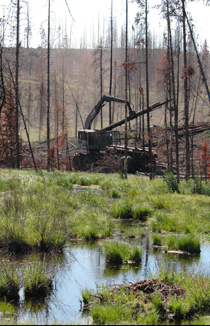 Dr. Richard Hutto summarizes his research into the ecological effects of severe wildfire as follows:
"The very fires often regarded as 'unnatural' and 'destructive' are the very fires that provide the best conditions for the most fire-dependent plant and animal species.
Land managers can't create the magic through severe cutting, fire is critical. . . many people believe that the conditions present after a clearcut or following one of the newer green-tree retention or forest restoration cuts are basically the same as those present after a severe fire. They are wrong."
(Read Full Article)
Page: ←12345678910111213141516171819

