

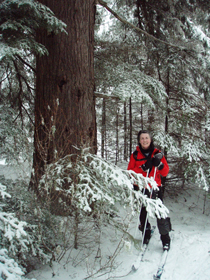
 "Many foresters have long assumed that trees gradually lose their vigour as they mature, but a new analysis suggests that the larger a tree gets, the more kilos of carbon it puts on each year."
This new study reported in the journal Nature helps counter the Forest Service and industry argument that logging native and old forests will help sequester more carbon in the younger vegetation and help reduce global warming.
Even more work remains to be done, however, to convince the Forest Service and industry to leave dead trees in the forest to continue sequestering and recycling carbon. The Department of Agriculture recently awarded a $10 million grant to five universities and Northern Rockies research stations to figure out how to turn dead trees into biofuels. Read the Missoulian article here and our response to it here.
It is time to work with nature, not against it!
 Be in good cheer this Holiday Season and pat yourself on the back while you are at it!
Montana just designated Lake Alva as "no wake," returning a bit of peace and quiet to nesting loons and thoughtful paddlers!
Thanks to people like you, the Missoulian reports that 66% of public comments supported no wake or no motors for Lake Alva!
HAPPY HOLIDAYS, HAPPY NEW YEAR, and THANK YOU for your generous response to our calls to action!
The Holidays 2013 issue of Swan View's News celebrates how simplifying and slowing down our lives can help save the planet!
Click here to view or download our Holidays 2013 newsletter.
Here is the Table of Contents:

Please DONATE NOW to support our work and help us raise the $14,000 needed to meet our year-end budget!
Thank you for your support!
 You can help prevent the logging of ecologically important burned forests on Condon Mountain today!
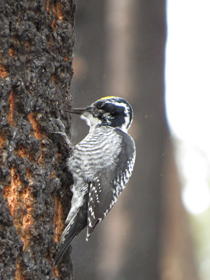
When we toured a proposed logging unit with the Flathead National Forest yesterday, the woodpeckers were out in force emphasizing the importance of trees both live and dead to the circle of life!
Click here to see our video of an American Three-toed Woodpecker feeding on beetle larvae in proposed logging unit #8 - nature's way of controlling beetle populations.
Click here to see Dr. Dick Hutto describe and show how 50 bird species thrive on burned forests and how many use the nesting holes left behind by "pathfinder" Black-backed Woodpeckers. Hutto explains elsewhere that a half-dozen other "pathfinder" woodpeckers, like the American Three-toed, also leave behind nesting cavities used by other species of birds and even small mammals.
Click here to read a letter by 250 scientists that say "the resulting post-fire community is one of the most ecologically important and biodiverse habitat types in western conifer forests" and that "post-fire logging does far more harm than good to the nation's public lands."
Please take a moment to email Ranger Rich Kehr ( rkehr@fs.fed.us ). Urge him to not "salvage" log in the 2012 Condon Mountain fire area! The trees are not going to waste and don't need to be "salvaged." They are being used by wildlife and will help replenish the soil!
And remember, you can Donate Now and have your support of our work doubled by Cinnabar Foundation through November!
Our Fall 2013 edition of Swan View's News looks at Flathead Forest Plan revision and how you can get involved to help conserve quiet habitats for fish, wildlife and people!
Click here to view or download the Fall 2013 newsletter.
Here is the table of contents:

Please DONATE NOW to support our work (and have your donation doubled by Cinnabar Foundation by Nov 30)!
Mark Nov 17 for our Annual Membership Meeting!
Thank you for your support!

Your comments are needed by Aug 1 to stop removal of Endangered Species Act protections for grizzly bears!
Send a quick email to NCDECS@fws.gov TODAY!
Here are some comments to consider:
1. Do not attempt to de-list disconnected grizzly bear populations individually, at only hundreds of bears each!
2. Wait until at least 5,000 bears are again biologically connected to one another in the six Lower 48 ecosystems, as science requires!
3. Continue securing bear habitat in the Northern Continental Divide Ecosystem and elsewhere to sustain recovery!
4. Do not relax mortality quotas to allow sport hunting of grizzly bears and increased agency trapping!
5. Keep ESA protection of grizzly bears in place!
Click here for more information.
THANK YOU for taking a few moments TODAY to keep grizzly bears around TOMORROW!
Fish and Wildlife Service has taken the first step to remove Endangered Species Act protection from grizzly bears in the Northern Continental Divide Ecosystem, releasing its Draft Conservation Strategy for public comment.
Please send a short email by August 1 to FWS (NCDECS@fws.gov) insisting that full Endangered Species Act protection for grizzly bears not be replaced by a lame "conservation strategy!"
Click here to read our detailed letter to Fish and Wildlife Service.
Click here to access the Draft Conservation Strategy.
PLEASE ACT NOW: The Conservation Strategy would remove legal protections of grizzly bear, remove habitat security protections, and decrease the NCDE grizzly bear population through sport hunting and relaxed mortality quotas.
The NCDE and Yellowstone populations would be "de-listed" from ESA protection though they number less than 1,000 and 600 respectively, are no longer biologically connected, and in spite of research showing some 5,000 bears must be well connected by secure habitat within and between the remaining six Recovery Zones in Montana, Wyoming, Idaho, and Washington!
Read more in our Summer 2013 newsletter. Its table of contents is shown below.


Please support Montana Department of Fish, Wildlife and Parks' "no-wake" proposal for Lake Alva, for the protection of fish, wildlife and people!
Your comments in July 2012 convinced MDFWP to make this proposal, now it needs to hear lots of public support for it!
Simply go to http://fwp.mt.gov/news/publicNotices/armRules/pn_0137.html and submit your comments by June 14!
You'll also find a briefing paper there summarizing the proposed rule in plain language - and announcement of a June 5 public hearing in Seeley Lake.
High speed motorized uses of this small lake, nestled between the Swan Range and Mission Mountains, is making it virtually impossible for loons to nest there and for people to enjoy quiet paddling and fishing.
Thank you for helping return a bit of quiet and sanity to Lake Alva!

You can help support protection of wolverine under the Endangered Species Act in just 5 minutes, but you must do so by May 6!
Just follow the easy link below to let U.S. Fish and Wildlife Service know how you feel about its proposal to list the wolverine as "threatened" by climate warming, trapping and fragmented habitat!
To comment by May 6:
A. Go to http://www.regulations.gov.
B. Enter FWS-R6-ES-2012-0107 in the Search Box.
C. On the resulting page, hit the Comment Now button.
We suggest you ask USFWS to:
1. List the wolverine as "endangered" rather than "threatened" to provide greater protection under the ESA.
2. Identify snowmobiling and logging as clear threats to wolverine and their secure use of the deep snow pack and old forests they depend on to survive and raise young.
3. Permanently ban the trapping of wolverine, as proposed.
When done, simply hit the Submit button!
To learn more about USFWS's listing proposal see pages 2 and 3 of our Winter-Spring 2013 newsletter.
To see our comments and photos showing USFWS how snowmobiling threatens wolverine on the Flathead National Forest, click here.
To see more comprehensive comments submitted on behalf of Swan View Coalition and 24 other groups by the Western Environmental Law Center, click here.
THANK YOU for taking 5 minutes to help wolverine, an increasingly rare critter endangered by climate warming, logging, snowmobiling, and "sport" trapping!
Our Winter-Spring 2013 edition of Swan View's News tells why wolverine are threatened by climate warming and what you can do to help!
Click here to view or download this newsletter.
Below is the table of contents:

Please DONATE NOW to help us continue our work!
Thank you for your support!
Page: ←123456789101112131415161718→

