

The Winter-Spring 2012 issue of Swan View's News describes the interplay of science, litigation, politics, and collaboration in the restoration of the Big Creek watershed on the Flathead National Forest.
You'll want to read this issue cover-to-cover if you'd like to know why citizen advocacy and litigation are so often necessary to give voice to the needs of fish, wildlife and people!
Winter-Spring 2012 Swan View's News (pdf).


"The Montana Department of Environmental Quality and Flathead National Forest announced the news Thursday that Big Creek had been removed from the state's list of impaired waters. . .
Practices for reducing sediment . . . included decommissioning 60.6 miles of forest logging roads, removing 47 culverts and replacing 19, improving 89 miles of roads to decrease stormwater runoff; revegetating 25 acres of eroding uplands, and working with Montana Fish, Wildlife and Parks to improve the amount of large wood in headwater streams that feed Big Creek. . .
Road building and timber harvesting led to accelerated soil erosion and substantial increases in the amount of sediments delivered to Big Creek."
Read the full Daily Inter Lake article here.

"Owing to the peculiarities of forest net primary production humans would appropriate ca. 60% of the global increment of woody biomass if forest biomass were to produce 20% of current global primary energy supply.
We argue that such an increase in biomass harvest would result in younger forests, lower biomass pools, depleted soil nutrient stocks and a loss of other ecosystem functions.
The proposed strategy is likely to miss its main objective, i.e. to reduce greenhouse gas (GHG) emissions, because it would result in a reduction of biomass pools that may take decades to centuries to be paid back by fossil fuel substitution, if paid back at all.
Eventually, depleted soil fertility will make the production unsustainable and require fertilization, which in turn increases GHG emissions due to N2O emissions.
Hence, large-scale production of bioenergy from forest biomass is neither sustainable nor GHG neutral."
Read or download the full Bioenergy paper here.
Read the Oregon State University article about this paper here.
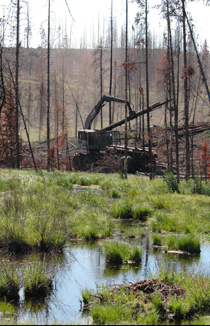 Dr. Richard Hutto summarizes his research into the ecological effects of severe wildfire as follows:
"The very fires often regarded as 'unnatural' and 'destructive' are the very fires that provide the best conditions for the most fire-dependent plant and animal species.
Land managers can't create the magic through severe cutting, fire is critical. . . many people believe that the conditions present after a clearcut or following one of the newer green-tree retention or forest restoration cuts are basically the same as those present after a severe fire. They are wrong."
(Read Full Article)
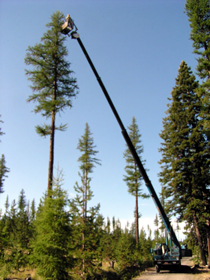 Flathead National Forest wants to cut down 270 of its genetically best, big larch trees simply to collect their cones for seed one time, rather than pick the cones or drop select branches to the ground!
Please write a short email or letter today and urge the Flathead to use time-proven, non-lethal methods to collect larch cones and seed for its nurseries!
See here and at right how the Ochoco National Forest uses a lift truck to pick larch cones and lets the trees live to see another day and another generation!
The Flathead has no shortage of big larch trees along roads at various elevations and microclimates to suit its genetic selection process - and there remain plenty of non-lethal options where a lift truck cannot be used!
Tell the Flathead to let 270 of America's best 2-foot diameter larch trees live on to spread their seed for future generations in the wild - and for nursery seed collection in the future!
Email Marsha Moore at memoore@fs.fed.us, phone her at 406-758-5325, or mail her at Flathead National Forest, 650 Wolfpack Way, Kalispell, MT 59901.
Comments must be submitted by April 16, 2012.
Read Swan View Coalition's comment letter here.
Read Flathead National Forest's press release here.
Welcome the New Year by enjoying video Moments of Peace and Quiet on Swan View's YouTube Channel! Revisit these short Swan Range videos whenever you need a break from the daily grind, but can't get outdoors!
You can help the Swan Rangers maintain trails in the Swan Range.
We have a volunteer agreement with the Forest Service to remove brush and deadfall, improve trail tread, and help control erosion on Swan Range trails in the Swan Lake and Hungry Horse Ranger Districts.
See example 'before and after' Strawberry Lake Trail photos, below. Click here to see more photos of our trail work!
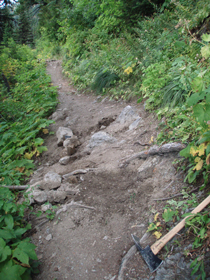


We use hand tools and no power tools.
If you are reasonably physically fit and would like to help, email Keith Hammer at keith@swanview.org!
Page: ←12345678910111213141516171819

